

I've spent the last 18 months evaluating AI recruiting tools for agency owners, founders, recruiters, and VPs of People who keep asking me the same question: "Which one should I actually use?" Every time I go looking for a good comparison, I find the same listicle recycled by 15 vendor blogs, all suspiciously generous to every tool they review. So here's a refreshed honest take with what the review sites won't tell you, including the lawsuits, the acquisitions, and the price tags that doubled in the last six months.
TL;DR: If you're a startup or agency that wants AI to handle the full pipeline (sourcing through scheduled interview), Yander is the strongest 2026 pick at $89/mo paid plans plus a free tier. If you run high-volume hourly hiring, Paradox is now part of Workday (acquisition closed late 2025) and Humanly is the only remaining independent leader in that segment. If you're enterprise tech and your due-diligence team has compliance teeth, Eightfold has serious lawsuit exposure as of January 2026 that you should know about before signing. Workable, Ashby, and Manatal remain the strongest mid-market and SMB picks. Skip Greenhouse and the older ATSes if you specifically want AI as the core product rather than as a feature bolted onto an ATS.
What changed in AI recruiting in 2026
Three things shifted since the April version of this article that anyone evaluating tools now needs to know about.
The category consolidated through acquisitions. Workday signed a definitive agreement to acquire Paradox on August 21, 2025. SAP closed its SmartRecruiters acquisition on September 11, 2025. Humanly acquired Sprockets, Qualifi, and HourWork all on October 14, 2025 (three deals in one day). Teamable became part of Humanly in May 2024. Sapling rebranded fully to Kallidus. The independent AI-recruiting vendor list is shorter than it was 12 months ago, and several "best of 2026" listicles still being published haven't caught up.
Agentic AI moved from marketing claim to product reality. Every major vendor now ships an autonomous AI agent: Juicebox Agents, Humanly's conversational stack, Eightfold's Agentforce integration with Salesforce (launched September 30, 2025), Foundire's AI Intelligent Interviewer, Hiry AI's 24/7 phone-screening agent. The distinction between "AI as a feature" and "AI as the actual worker" stopped being marketing fluff. Some of these products genuinely automate work that recruiters were doing manually 12 months ago. Some still don't.
Compliance teeth grew. Eightfold faces a class-action lawsuit filed January 2026 alleging the company scraped data on over 1 billion workers without consent and scored applicants through an opaque algorithm before any human review (more on this below). NYC Local Law 144 bias-audit enforcement is now well into its second year. Illinois's AI hiring disclosure law took effect January 1, 2026. Colorado's AI Act applies June 30, 2026. The EU AI Act's high-risk obligations for CV-screening tools are now phased to apply from December 2, 2027 following the Digital Omnibus provisional agreement reached May 2026. Buying an AI recruiter without checking its compliance posture is no longer a defensible position for any company with a legal team.
What counts as a "full-stack AI recruiter"
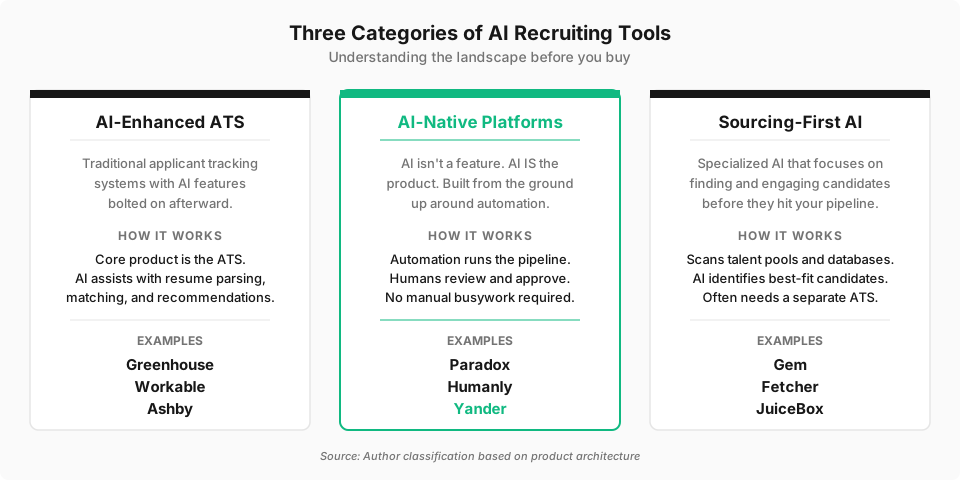
The phrase "AI recruiting software" gets stretched across at least three different product categories. Knowing which category you actually need saves you from buying the wrong thing.
Sourcing-first AI finds candidates. Tools like Gem, SeekOut, hireEZ, Fetcher, and Juicebox specialize in candidate discovery and matching. Covered in depth in our best AI candidate sourcing tools in 2026 guide.
ATS with AI features bolted on uses AI to enhance an existing applicant-tracking workflow. Greenhouse, Lever, Workable, and Ashby fall here. They're great if you primarily want an ATS and AI is a nice enhancement. Covered in our best ATS for startups in 2026 piece.
Full-stack AI recruiters, the category this piece covers, are tools where AI is the actual product. The AI sources candidates, screens them against criteria, schedules interviews, sometimes conducts them, and produces a ranked shortlist. The hiring manager's involvement starts when a human conversation is genuinely needed. Yander, Paradox (now part of Workday), Humanly, Eightfold, Foundire, Hiry AI, and Metaview live in this category. Some span more of the funnel than others.
For the broader recruitment-automation taxonomy across all categories (outreach, screening, scheduling, video interview, ATS workflow, referral, onboarding), see our best recruitment automation software in 2026 piece.
How I evaluated these 12 tools
Same six criteria as the prior version of this article, updated for the 2026 state of the category:
- Funnel coverage. How many hiring stages does AI actually do work in? Sourcing only, or sourcing through scheduled interview?
- Pricing transparency. Can you know the price without a sales call?
- Customer credibility. Named customers on the vendor's own site, especially at the segment they target?
- Ownership stability. Recent acquisitions affecting roadmap clarity?
- Compliance posture. Published bias audits, jurisdictional coverage (NYC, Illinois, Colorado, EU), and any active regulatory or litigation exposure.
- Honest UX. Demo videos, customer reviews on G2 and Capterra, public complaints. The cons matter as much as the marketing claims.
Where a claim below is based on direct experience, I say so. Where it's pulled from the vendor's own site or recent press, the language reflects that.
At a glance: AI recruiting software in 2026
| Tool | Best for | Starting price | Public pricing? | Notable signal |
|---|---|---|---|---|
| Yander | Startups and agencies wanting full-pipeline automation | Free / $89+ per mo | Yes, all tiers public | Plugs into Greenhouse, Workable, Ashby, Lever |
| Humanly | High-volume hourly hiring (post-acquisition stack) | Demo-gated | No | Acquired Sprockets, Qualifi, HourWork (Oct 2025), $25M Series B (May 2026, led by SEEK Investments) |
| Eightfold | Fortune 500 enterprise talent intelligence | Demo-gated; est. ~$7-10 PEPM analyst | No | Active class-action lawsuit Jan 2026 over scraping + opaque scoring |
| Paradox (Workday) | Existing Workday customers doing hourly hiring at scale | Demo-gated; est. $25K-$200K+/yr | No | Acquired by Workday Aug 21, 2025; Chipotle, McDonald's, GM customers |
| Gem | Recruiting orgs scaling outbound | Tiered; Startups public, rest custom | Partial | 800M+ profiles, $148M raised, established player |
| Ashby | Mid-market data-driven recruiting | $400/mo Foundations (up to 100 employees) | Foundations tier public | $50M Series D July 2025, Cursor/Ramp/Notion customers |
| Workable | SMBs wanting ATS + light HRIS bundled | $299/mo Standard | Yes, all tiers public | 30,000+ customers, 15-day free trial no CC |
| Foundire | Teams wanting AI to conduct the interview itself | Free / $79/mo Pro / custom | Yes | Launched Nov 2025; AI Intelligent Interviewer |
| Hiry AI | US and Canada full-stack AI with phone interviews | Demo-gated | No | 24/7 AI-conducted phone screens |
| Manatal | Agencies and SMBs on a budget | $15/user/mo annual | Yes, all tiers public | Cheapest credible AI ATS, bootstrapped Bangkok |
| Metaview | Multi-agent platform across sourcing, review, notes | Free / $100 / $300 per mo (Sourcing Agent) | Yes for Sourcing Agent | $35M Series B from GV (June 2025), 3,000+ customers |
| SmartRecruiters (SAP) | High-volume enterprise inside SAP ecosystem | Essential $14,995/yr; rest custom | Partial | Acquired by SAP Sep 11, 2025 |
The 12 best AI recruiting platforms in 2026
1. Yander
Best for: Founders, agencies, and Heads of Talent who want one tool to source, screen, and schedule interviews across a global candidate pool without stitching together five products.
Pricing: Free tier (200 sourced candidates, no credit card). Paid plans from $89/month billed annually. No placement fees. Same pricing regardless of which surfaces you use.
What it does: Sources from a 428M-profile global pool with semantic search that handles fuzzy briefs ("senior engineer with payments experience who worked at a fast-growing fintech"). Runs structured async assessments scored against your custom rubric. Plugs into Greenhouse, Workable, Ashby, Lever. Yander Pulse layers continuous quit-risk monitoring on top of the people you hire.
Honest limits:
- Yander doesn't conduct AI interviews. If you want the AI to run the candidate conversation itself, Foundire or Hiry AI are the category. Yander stops at structured async assessments and hands the interview loop back to your team.
- Yander is not an ATS. If you need pipeline tracking, scorecards, and EEO reporting, pair Yander with whatever ATS you already use.
- The rubric is your responsibility. If you can't articulate what good looks like for the role, the assessment doesn't translate that for you.
Verdict: The 2026 buy if your hiring process works but doesn't surface enough qualified candidates fast enough. Plugs in instead of replacing. Same product whether you're a 5-person startup or a 200-person company.
2. Humanly
Best for: Mid-market through Fortune 500 hiring at hourly and frontline scale. Now the only remaining independent specialist in that segment after Paradox went to Workday.
Pricing: Demo-gated. No public tiers. No analyst PEPM estimates available.
What it does: End-to-end conversational AI hiring across sourcing (Teamable, acquired May 2024), screening (Sprockets, acquired Oct 14, 2025), voice phone interviews (Qualifi, acquired Oct 14, 2025), scheduling, and post-hire retention (HourWork, also acquired Oct 14, 2025). Three acquisitions in a single day plus a $25M Series B announced May 21, 2026, led by SEEK Investments with MassMutual Catalyst Fund participating new and Drive Capital and Zeal Capital Partners following on. Total funding around $56M.
Honest limits:
- Absorbing 4 acquired products in 18 months means UI fragmentation and roadmap uncertainty are likely through 2026-2027.
- Named customer logos are not visible on the homepage; the site blocks scrapers and Wayback is unreachable. Buyer references require a sales call.
- No PEPM pricing benchmark available, so budget anchoring is hard without a quote.
Verdict: The strongest 2026 pick if hourly and frontline hiring is your problem. The acquisitions stack covers source-screen-interview-hire-retain in one platform. Hold off if you specifically need integration stability over feature breadth.
3. Eightfold
Best for: Fortune 500 enterprises (10K+ employees) and public sector buyers needing talent-intelligence at scale across multiple workforce modules.
Pricing: Demo-gated. Analyst estimates around $7-10 PEPM (roughly $168K/yr at 2K employees, $2.1M+/yr at 25K). Implementation $5K-$50K. Vendor publishes no list price.
What it does: "Talent Intelligence" model claimed to be trained on 1B+ profiles, powering four modules from one data layer: Talent Acquisition, Talent Management, Workforce Exchange, Resource Management. Co-founders Ashutosh Garg (ex-Google/IBM) and Varun Kacholia (ex-Facebook ML) shipped a Salesforce Agentforce integration on September 30, 2025. Customers include Salesforce, Vodafone, the U.S. Department of Defense Innovation Unit, Bayer, Capital One, BNY Mellon, EY, Cloudflare, HP, S&P Global, Coca-Cola Europacific Partners. Over $400M total raised, $220M Series E in June 2021 led by SoftBank at $2.1B valuation. 2024 ARR around $96.6M.
Honest limits:
- Active class-action lawsuit filed January 2026 alleging Eightfold scraped data on over 1 billion workers without consent, scored them on a 0-5 scale via an opaque algorithm, and filtered candidates before human review. Claims include Fair Credit Reporting Act violations, California consumer law violations, and bias. This is a material procurement red flag in 2026. Your legal team will see it during diligence.
- Slow customer support per multiple G2 reports.
- Weak native ATS; typically needs to bolt onto another system.
- Limited analytics and opaque pricing.
Verdict: Genuinely powerful for enterprise scale but the lawsuit makes this a "talk to your legal team first" purchase in 2026. If your DPIA process is strict, this becomes hard to ship.
4. Paradox (now Workday Talent Acquisition)
Best for: Enterprise high-volume hourly hiring (retail, QSR, hospitality, healthcare, logistics) where you're already a Workday customer or planning to become one.
Pricing: Demo-gated. Third-party estimates $25K-$100K+/yr typical, $200K+ for large frontline. No vendor list price.
What it does: Olivia is a conversational AI handling screening, scheduling, and candidate communication via chat, SMS, and voice in 100+ languages. Customer-cited results: Chipotle reduced time-to-hire from 12 days to 4 days. McDonald's, GM, FedEx, IHG, Kraft Heinz, Marriott, Nestlé, Compass Group, Sodexo are all named customers. ~1,000+ enterprise clients. Acquired Eqtble (people analytics) February 5, 2025.
Status change: Workday signed a definitive agreement to acquire Paradox on August 21, 2025. Paradox is now effectively no longer independent. The product roadmap will be absorbed into Workday Talent Acquisition over the next 12-24 months.
Honest limits:
- Workday absorption means roadmap uncertainty through 2027. If you're not a Workday shop, this becomes a riskier long-term bet.
- Text/chat-only. No voice interviews. Some candidates report the conversation feels repetitive or impersonal at high volume.
- Pricing remains opaque despite Workday ownership.
Verdict: Still genuinely the strongest pick for the hourly-volume use case, but the procurement question now is whether you're buying into Workday's broader stack. If you're already on Workday, this is a natural extension. If you're not, evaluate Humanly first.
5. Gem
Best for: Mid-market through enterprise recruiting orgs that want CRM, outbound automation, and sourcing in one platform.
Pricing: Tiered by company size. Startups tier (up to 100 FTE) has visible pricing on the homepage. Growth (101-1,000 FTE) and Enterprise (1,000+ FTE) are custom-quoted.
What it does: Recruiting CRM with sourcing automation across 800M+ profiles, AI-personalized outreach, and integrated analytics. Founded 2017 in San Francisco. Raised approximately $148M total across rounds, most recent priced round Series C in 2021. 1,200+ customer companies. The AI personalizes outreach messages at icebreaker level. Gem's own data claims 30-40% higher positive response rates vs generic templates.
Honest limits:
- Cost is the most-cited G2 complaint. Per-seat pricing runs around $3,600-$4,000/seat/year per third-party reports.
- LinkedIn integration sometimes doesn't pull contact data reliably.
- Reporting dashboard customization is limited and bugs are reported.
- Steep learning curve.
Verdict: The mature outbound-recruiting incumbent. Strong choice for an established recruiting org that wants to scale outbound through a single platform. Overkill for a 5-recruiter team or for companies whose hiring volume doesn't justify the per-seat cost.
6. Ashby
Best for: Mid-market teams (50-1,000 employees) that want a modern all-in-one with strong analytics and AI features bundled rather than bolted on.
Pricing: Foundations $400/month for up to 100 employees (10% annual discount). Plus (101-1,000 employees) custom. Enterprise (1,000+) custom. Foundations is the only public tier with a published dollar amount.
What it does: Unified ATS + CRM + scheduling + analytics in one product with native AI features. Founded 2018 in San Francisco from Y Combinator's W19 batch. $128M total funding including a $50M Series D in July 2025 co-led by Alkeon Capital and Lachy Groom. Customer base doubled to 2,700+ in 2024-2025; ARR up 135% YoY. Named startup customers include Cursor, Ramp, Notion, Linear, Replit, Mercury, Vanta, Harvey, and Shopify.
Honest limits:
- Steep learning curve. The scheduling section alone has 14 settings tabs.
- English-only.
- No Boolean search; some sourcers find this frustrating.
- AI credits and advanced analytics cost extra on top of base price.
Verdict: The 2026 default pick for an AI-native YC or Series A startup. The combination of public per-month pricing, modern AI-first architecture, and the customer logo wall is rare.
7. Workable
Best for: SMBs (up to 50 employees) wanting an ATS plus lightweight HRIS bundled at transparent monthly pricing.
Pricing: Standard $299/mo, Premier $599/mo, Enterprise $719/mo (baseline for 1-20 employees, scales with headcount). Annual saves 20%. 15-day free trial, no credit card required.
What it does: AI candidate screening and scoring, AI job descriptions with tone control, AI Screening Assistant that summarizes candidate-job fit, passive candidate sourcing, salary estimation for US and UK roles. 30,000+ customers across 100+ countries. 2.1M hires processed. Founded 2012 in Athens, Greece.
Honest limits:
- Reporting and analytics are limited compared to Ashby or Gem.
- Customer support quality is inconsistent per G2 reports.
- Standard tier requires you to buy add-ons (texting $89/mo, video $109/mo, assessments $59/mo) that competitors bundle.
- Can't geo-filter applicants.
Verdict: The safe mid-tier pick if you want one tool covering ATS plus light HRIS and aren't picky about which startup logos use it. Pair with Yander if sourcing is your bottleneck.
8. Foundire
Best for: Teams that specifically want AI to conduct the interview itself rather than route candidates back to humans.
Pricing fully public:
- Free: Up to 2 active jobs, 50 resume parses/month, AI dialogue interview, 1 Global People trial.
- Pro: $79/mo (or $948/yr, saving 17%). 100 active jobs, 1,000 resume parses/month, 300 credits/month, advanced AI interviewer, video recording, comprehensive analysis.
- Enterprise: Custom. Unlimited interview minutes, unlimited resume parsing, dedicated account manager, 24/7 priority support, SLA.
What it does: Sources from 800M+ profiles, then handles the interview itself via an "AI Intelligent Interviewer." Automated invitations, reminders, result notifications, AI-scored evaluations. Backed by Pio, whose parent suite includes Employer of Record, Contractor, Global Work Visa, and Payroll services.
Honest limits:
- Genuinely new: launched at the 8th CIIE in November 2025, so only a few months in market.
- AI-conducted interviews carry compliance considerations. Some candidates will self-select out. EEOC and EU AI Act posture matters more here than for pure-sourcing tools.
Verdict: Worth a look if AI-conducted interviews are specifically what you need and you don't mind a young product. If your team prefers to own the interview loop, this category isn't your fit.
9. Hiry AI
Best for: US and Canadian employers wanting a full-stack AI hiring platform with AI-conducted phone interviews.
Pricing: Not published. Demo or sales contact required.
What it does: Full-stack AI: job posting (2-minute setup), automatic AI screening + scoring + ranking, AI-conducted phone interviews running 24/7, role-specific skills assessments, calendar-synced scheduling. AI trained on US and Canadian job-market data specifically. Reports 1,000+ companies using the platform.
Honest limits:
- No public pricing.
- US and Canada focus means weaker fit if you're hiring across Europe or Asia.
- AI-conducted phone interviews carry the same compliance considerations as Foundire (EEOC, state laws, EU AI Act for EU candidates).
Verdict: Reasonable evaluation if you're US/Canada and want AI to handle both screening and interviews. Compare directly against Foundire since they target the same category at different price transparency levels.
10. Manatal
Best for: Recruiting agencies and global SMBs that want a modern AI ATS at the lowest per-user pricing in the market.
Pricing: Professional $15/user/mo annual ($19 monthly). Enterprise $35/user/mo ($39). Enterprise Plus $55/user/mo ($59). 14-day free trial, no credit card.
What it does: AI candidate scoring, social media profile enrichment from 20+ platforms, CRM for agency client management, 2,500+ job-board integrations. 10,000+ recruiting teams across 135+ countries. Founded January 2019 in Bangkok, Thailand. Bootstrapped, no VC.
Honest limits:
- Reporting is the most-cited complaint on G2.
- API access locked to the $55/user/mo Enterprise Plus tier.
- Per-user pricing means cost scales with your recruiting team size rather than your overall company size. A 20-recruiter agency pays $300/mo Professional.
Verdict: Honest budget pick. If you're a global SMB or agency and the brand-name logo wall doesn't matter to you, Manatal Professional at $15/user/mo is the best per-dollar AI ATS in this list.
11. Metaview
Best for: Recruiting teams that want a multi-agent platform spanning sourcing, application review, and interview operations.
Pricing (Sourcing Agent, fully public): Free $0/mo (first 100 profiles), Pro $100/mo (200 profiles), Max $300/mo (unlimited), Enterprise custom. Usage-based (profiles sourced per month) rather than per-seat.
What it does: Repositioned from interview-notetaker to "Agentic Recruiting Platform" in 2025. Ships discrete AI agents for Sourcing, Application Review, Notetaker, and Reports, alongside Outreach and Job Posts products. Founded 2018 in London by Siadhal Magos (ex-Uber, CEO) and Shahriar Tajbakhsh (ex-Palantir, CTO). $35M Series B led by GV (Google Ventures) announced June 2025. ~$50M total raised. 3,000+ customers including Sony, Brex, ElevenLabs, Deliveroo.
Honest limits:
- Multi-product surface means you have to think carefully about which agents you actually need.
- Sourcing Agent operates via web search rather than a proprietary profile index. Trade-off is freshness vs depth.
- Outreach is a separate product on the platform rather than bundled with the Sourcing Agent.
Verdict: Worth a serious look if you want a multi-agent platform with published pricing and modular adoption. Strongest moment is when you want sourcing, application review, and interview intelligence stitched together by one vendor.
12. SmartRecruiters (now SAP)
Best for: High-volume enterprise hiring (retail, hospitality, gig) already on or moving to the SAP stack.
Pricing: Essential plan starts at $14,995/year (the only public number). Professional, High Volume, Complete tiers all "Request Pricing."
Status change: Acquired by SAP on September 11, 2025. Operates as a standalone product within SAP, fully interoperable with SAP SuccessFactors.
What it does: Conversational AI Chat + Dynamic Scheduling (claims 97% admin reduction) + AI Talent Matching + AI Screening + AI Hiring Agent. 4,000+ customers including Air New Zealand, Avery Dennison, Domino's, Foster Farms, KPMG, LinkedIn, McDonald's, ServiceNow, Sodexo, Square, Visa, Toshiba, Etsy. 60% time-to-hire reduction with Winston AI hiring agent. Founded 2010 in San Francisco.
Honest limits:
- Post-SAP ownership. Long-term independence and roadmap clarity uncertain.
- Pricing opacity remains; only Essential tier shows a number.
- Enterprise-only pricing locks out anything below Series C scale.
Verdict: Strong pick if you're already on SAP or comfortable with SAP ownership and hire at high volume. Less compelling if vendor independence matters to you.
AI recruiting software vs traditional ATS
This question shows up in nearly every Page 1 result so worth answering directly.
A traditional ATS (Greenhouse, Workable, Lever) is the system of record for candidates. It tracks who's in the pipeline, who's been rejected, who's at offer stage. AI features bolted onto an ATS make those workflows faster (auto-generated job descriptions, candidate-summary AI, score-aware reporting). The ATS is still the product.
A full-stack AI recruiter (Yander, Paradox/Workday, Humanly, Foundire) is software where AI does the actual recruiting work. It sources candidates, screens them, schedules interviews, sometimes conducts them. The hiring manager's involvement starts when human judgment is genuinely needed.
The honest framing: most companies still need an ATS for pipeline tracking, compliance reporting, and offer management. Adding a full-stack AI recruiter on top of the ATS is what cuts time-to-hire and recruiter workload. They're complementary tools that solve different problems. Pick the AI recruiter that integrates cleanly with whatever ATS you already use or plan to use.
AI recruiting software pricing in 2026
Three rough price bands cover most of the market:
Free to $50/month per user. Manatal at $15/user/mo, Foundire Free, Yander Free tier, Metaview Free, BreezyHR Bootstrap, Zoho Recruit Free. Good for solo founders or recruiters running 1-3 reqs at a time.
$200 to $1,000/month total. Yander paid plans from $89/mo, Workable Standard at $299/mo, Foundire Pro at $79/mo, Ashby Foundations at $400/mo, Metaview Pro at $100/mo. Good fit for SMBs (5-50 employees) running 2-10 concurrent reqs.
Enterprise tier, $30K to $200K+ per year. Paradox/Workday, Eightfold, Humanly, Gem at growth+, SmartRecruiters at scale, custom Ashby Plus and Enterprise tiers. Required if you're hiring at hourly volume, running multiple recruiting teams, or need SOC 2 / FedRAMP / advanced compliance features.
The cost-per-hire framing matters more than the sticker price. A $4,000/seat/year tool that lets a recruiter make 25% more hires is cheaper than a $1,500/seat/year tool that doesn't change throughput.
The thing nobody else will say (and the lawsuits)
This is the section vendor blogs skip and the section your legal team will care about.
Eightfold has an active class-action lawsuit filed January 20, 2026. The case is Kistler v. Eightfold AI, Inc. (Contra Costa County Superior Court C26-00214, removed to N.D. Cal. as 3:26-cv-00559). The lead legal theory is that Eightfold operated as an undisclosed consumer reporting agency under the federal Fair Credit Reporting Act and California's ICRAA, scraping data on over 1 billion workers, scoring them through an opaque AI on a 0-5 scale, and filtering candidates before any human review. Bias claims sit alongside the FCRA theory but are secondary. Whatever the outcome, this is a material procurement red flag in 2026. Any enterprise evaluation should include a conversation with your legal team about data provenance, automated-decision opacity, and what your DPIA process requires.
Workday faces ongoing AI-bias litigation. In Mobley v. Workday (N.D. Cal., July 12, 2024), Judge Rita Lin allowed an age-discrimination case to proceed against Workday as an agent of its client employers under Title VII, ADEA, and ADA, for the algorithmic screening it provides. The legal theory matters: liability extends from the employer using the AI to the vendor providing it. Anything you buy in 2026 needs to clarify in writing where the liability sits.
NYC Local Law 144 enforcement is now in its third year. Annual independent bias audits, public disclosure of audit results, and candidate notice requirements apply to any automated employment-decision tool used in NYC. Penalties: $500 for the first violation, up to $1,500 per day for each subsequent violation. Ask every vendor: do you publish current bias audits? Can you provide the audit document? Can your tool be configured to keep humans in the loop for every reject decision?
State laws are stacking on top. Illinois's AI-disclosure law for employment took effect January 1, 2026. Colorado's AI Act has a June 30, 2026 effective date (delayed from February 1, 2026 via SB 25B-004), though a federal court paused enforcement on April 27, 2026 while SB 26-189 moves through the Colorado House to narrow scope. California's automated-decision-system regulations under FEHA have been in effect since October 1, 2025.
The EU AI Act now phases high-risk hiring obligations from December 2, 2027 following the Digital Omnibus provisional agreement reached May 7, 2026 (pending final Official Journal publication). CV-ranking and candidate-scoring tools are classified as high-risk under Annex III §4 of the Act. If you sell into Europe, plan for these obligations in your vendor evaluation now.
A practical compliance checklist for every demo call:
- Is the tool configured to never auto-reject without human review? Get a screenshot.
- Does the vendor publish a current bias audit? Get the document. Check the date. Check who conducted it.
- Is the model trained on your historical hire data? If yes, ask about adverse-impact testing post-training.
- What's the candidate disclosure flow? Should be visible before application rather than buried in a privacy policy footer.
- What's the audit log retention policy? Should be at least 7 years for ADEA/Title VII compliance.
- What's the contractual liability split between vendor and customer on automated-decision outcomes?
- Has the vendor been named in any complaints, lawsuits, or regulatory investigations in 2024-2026?
The right answer to question 7 is "no" or a specific disclosure with current status. Vague answers are red flags.
How to actually choose
Three filters help you cut the shortlist quickly.
Match the funnel coverage to your bottleneck. If candidate volume is your problem, pick a tool that sources well (Yander, Gem, Metaview). If screening throughput is your problem, pick a tool that automates assessment (Yander, Eightfold, Foundire). If high-volume hourly is your problem, pick the segment specialists (Paradox/Workday, Humanly).
Match the pricing model to your hiring volume. Per-user pricing (Manatal, Recruiterflow) punishes growing recruiting teams. Per-employee pricing (BambooHR, Rippling) punishes growing companies. Platform pricing (Yander at $89/mo) is stable as volume grows. Pick the model that doesn't punish your trajectory.
Match the compliance posture to your legal team's appetite. If your DPIA process is strict, Eightfold's lawsuit and any vendor without a published bias audit will be hard. If you sell into Europe, plan for EU AI Act compliance in your evaluation. If you operate in NYC, Illinois, or Colorado, the state-specific obligations are non-negotiable.
A concrete buyer-stage shortlist:
Solo founder hiring 1-3 people. Yander free tier. The bottleneck at this stage is finding qualified candidates, not tracking them.
5-50 person startup with 2-10 open reqs. Yander paid plans ($89/mo) plus Workable Standard ($299/mo) or Ashby Foundations ($400/mo) for the ATS layer.
50-200 person company with a dedicated TA team. Ashby Plus or Workable Premier plus Yander for sourcing and screening. Add Gem if outbound is the bottleneck.
500+ person company with multiple recruiters. Greenhouse or Lever for the ATS. Add Yander or Humanly as the AI recruiter layer. Eightfold only if you've cleared the lawsuit concern with your legal team.
Enterprise (5,000+) with high-volume hourly hiring. Workday with Paradox now (if already on Workday), or Humanly as the independent alternative.
FAQ
Q: What is AI recruiting software?
A: Software where AI is the primary product (rather than a feature on top of an ATS), automating the work of finding, evaluating, and scheduling candidates. The defining feature is that AI does work across multiple hiring stages. Yander, Paradox/Workday, Humanly, Eightfold, and Foundire are clear examples. Greenhouse with its AI features bolted on top is something different. It's an ATS with AI features. Both are valid purchases for different needs.
Q: What's the cheapest AI recruiting tool?
A: Manatal at $15/user/month annual is the lowest sticker price. Yander's free tier covers 200 sourced candidates with no credit card. Foundire and Metaview both have meaningful free tiers. The right answer depends on whether you want low per-user pricing (Manatal) or low total cost regardless of headcount (Yander).
Q: Best AI recruiting software for startups?
A: Yander for sourcing and screening (free tier or $89/mo). Ashby Foundations at $400/mo if you also need the ATS. Workable Standard at $299/mo as the safer middle pick. Skip enterprise-only tools at startup scale. Paradox/Workday, Eightfold, SmartRecruiters/SAP are premature below ~500 employees.
Q: Best AI recruiting software for agencies?
A: Manatal at $15/user/mo if budget is the binding constraint and you want CRM for managing client pipelines. Yander if you want full-pipeline automation across multiple client briefs. Recruiterflow at $149/user/mo if you specifically want an agency-shaped CRM.
Q: Best AI recruiting software for enterprise high-volume hiring?
A: Humanly is the strongest independent pick now that Paradox is part of Workday. If you're already on Workday, Paradox absorbed under Workday Talent Acquisition is the natural extension. SmartRecruiters (now SAP) for SAP shops. Hiry AI for US/Canada-specific high-volume.
Q: AI recruiting software vs traditional ATS. What's the difference?
A: An ATS organizes candidates through a defined pipeline. AI recruiting software does the actual recruiting work (sourcing, screening, scheduling, sometimes interviewing). Most companies need both: an ATS for tracking and compliance reporting, an AI recruiter for cutting time-to-hire. The cleanest stack at SMB scale is often a free or cheap ATS plus Yander. At enterprise scale, it's a full ATS plus a full AI recruiter, with clear contractual boundaries on which one owns automated-decision liability.
Q: How much does AI recruiting software cost in 2026?
A: Three bands. Free to $50/mo per user covers solo founders and very small teams (Manatal $15, Yander Free, Foundire Free, Metaview Free). $200 to $1,000/mo covers SMBs (Yander $89, Workable $299, Foundire $79, Ashby $400, Metaview $100). $30K to $200K+/year covers enterprise (Paradox/Workday, Eightfold, Humanly, Gem at scale, SmartRecruiters/SAP, custom Ashby Plus tiers).
Q: Does AI recruiting software auto-reject candidates?
A: Some tools auto-reject by default. Many can be configured to never reject without human review. This is the most important compliance question to ask on every demo. Get a screenshot of the setting that prevents auto-reject. NYC Local Law 144 makes this a regulatory question, not a preference one.
Q: What's the ROI of AI recruiting software?
A: Vendor-cited results typically land in three buckets. (1) Time-to-hire reduction: 30-70% (Paradox at Chipotle 12→4 days, SmartRecruiters 60% with Winston AI). (2) Recruiter productivity: 2-3x more candidate throughput per recruiter (Gem reports 30-40% higher response rates with AI-personalized outreach). (3) Cost-per-hire reduction: 20-40% when comparing automated vs manual workflows on equivalent roles. Calibrate vendor claims against your own baseline; the most credible signal is talking to a 2024-2026 customer at similar scale.
Q: How do I evaluate AI bias in these tools?
A: Ask for the tool's bias audit results. NYC Local Law 144 requires annual independent bias audits for any automated employment-decision tool used in NYC. Even outside NYC, the audit report tells you whether the vendor takes this seriously. If they can't produce one, that's a red flag. Also check active litigation: the Eightfold class action filed January 2026 and the Mobley v. Workday ruling are public signals you can use in evaluation. Vendors with no compliance posture and no published audit should be lower in your shortlist.
The honest final word
The AI recruiting category is genuinely useful in 2026 in a way it wasn't in 2024. The conversational AI agents from Humanly and Paradox work for hourly volume. The full-pipeline tools like Yander and Foundire actually cut recruiter workload. The talent-intelligence platforms like Eightfold genuinely surface candidates that traditional ATS searches miss.
But the category is also messier than vendor blogs make it look. Three major acquisitions in 2025 (Paradox into Workday, SmartRecruiters into SAP, Humanly absorbing four products in 18 months) reshaped the independent-vendor list. One major lawsuit (Eightfold, January 2026) is testing whether opaque scoring is legally defensible. State and EU regulations are stacking on top.
The right move for most buyers in 2026: pick the tool that solves your actual bottleneck (sourcing? screening? hourly volume?), at a price band that matches your scale, with a compliance posture that survives your legal team's review. Don't pick the tool with the loudest enterprise logo wall. Don't pick the cheapest just because it's cheap. Pick the one that does the actual work you're not doing today and stops doing it when the law requires a human in the loop.
If sourcing is your bottleneck, see our best AI candidate sourcing tools in 2026. If you need the broader recruitment-automation taxonomy across the full funnel, see our best recruitment automation software in 2026. If you're a founder weighing an ATS purchase specifically, see our best ATS for startups in 2026. The four pieces together cover sourcing, automation, ATS, and full-stack AI recruiting. The complete 2026 stack from an operator's lens.

Written by
Jordan Hayes
Co-founder
Jordan Hayes is the co-founder of Yander, the AI agent that recruits for you. He has spent the last decade building and operating businesses, with a focus on remote hiring, agency operations, and AI-augmented work. He writes about what's actually working in modern hiring, from someone running the playbook live.
